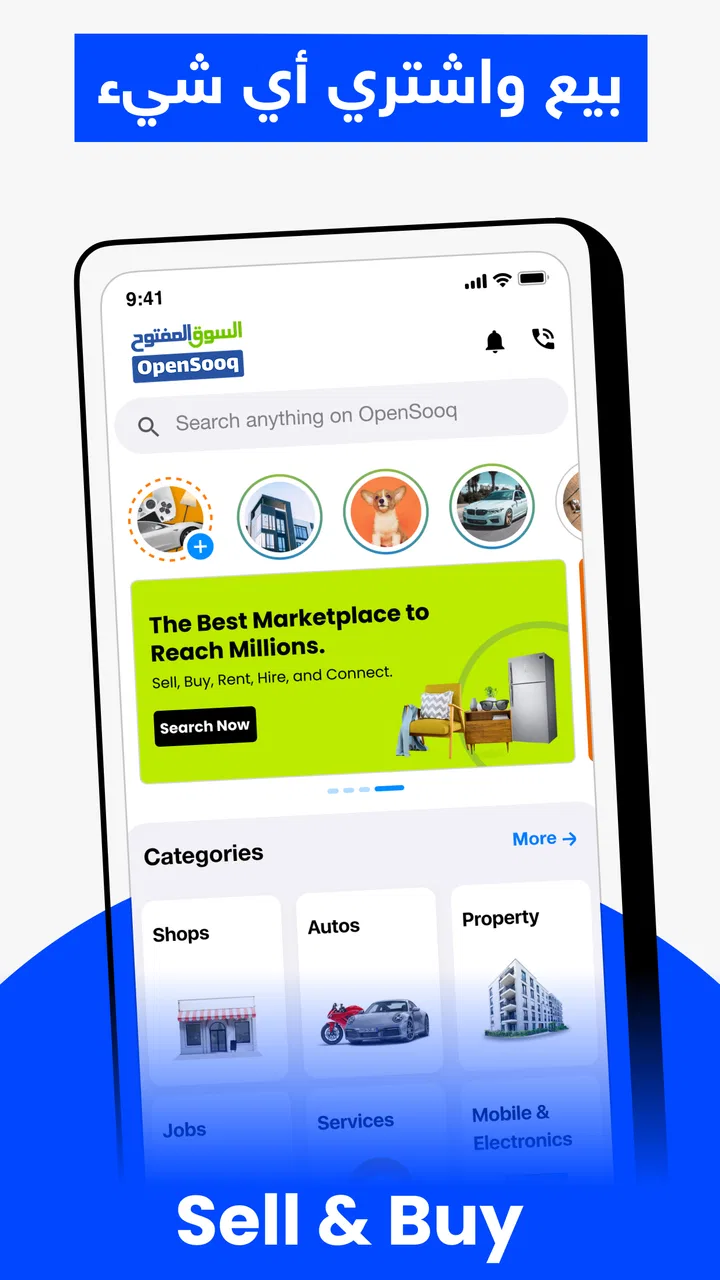
السوق المفتوح - OpenSooq
- 4.6
- Rating
- 10.00M
- Installs
- Free
- Price

 Analysis by App-foxy
Buying or selling locally is rarely as simple as finding an item and tapping a button. The real work is checking whether an advert is still relevant, asking the right questions, comparing nearby options, and deciding whether a seller or buyer feels trustworthy. That is where OpenSooq fits into my daily shopping habits: it brings cars, homes, electronics, jobs, and other local listings into one mobile marketplace rather than making me search across several unrelated places.
My experience with it is best described as practical rather than polished for its own sake. The app is useful when I already know what I want to find, but it also works well for browsing a local market and discovering what is available nearby. Because listings can change quickly, the quality of the experience depends heavily on the network connection, the freshness of individual adverts, and how carefully I communicate with the other person.
How OpenSooq feels when the connection matters
When the connection matters, I treat OpenSooq as a live conversation with a local market, not a catalogue I can trust to stay unchanged. I’ll cover how I keep a search useful when pages or replies lag, and why I separate what I’ve already checked from what still needs refreshing before I act.
You May Also Like

 Blood Strike: 2.5 Anniversary
Blood Strike’s Loadouts Turn Every Drop Into a Tactical Gamble
A close look at Blood Strike’s custom loadouts: how fast access to signature weapons reshapes its battle royale rhythm, rewards preparation, and narrows the gap between fights.

 Pandora - Music & Podcasts
Pandora’s Music Is Easy to Start, but Harder to Recover
Pandora’s strength is its low-effort path from a seed to a station. Its weak spot is how much confidence it asks you to place in connection, setup, and quiet recovery.

 8 Ball Pool
 Is Built on Rivalries, Rematches, and Routine
A close look at the rivalries, rematches, shared routines, and unanswered safety questions that turn a quick pool match into a persistent mobile community.

 Samsung Music
’s Quiet Strength Is Playing What You Already Own
Its reach comes less from spectacle than from dependable access to a personal library. That simplicity is both the app’s strongest retention engine and its ceiling.

 AccuWeather: Weather Radar
AccuWeather Review: A Quick, Clear Forecast for Everyday Decisions
For everyday plans, the best forecast is the one you can understand quickly. AccuWeather makes rain timing, radar, and local conditions easy to act on, with a few trade-offs.

 Hill Climb Racing
Why Hill Climb Racing Still Turns Crashes Into One More Run
A tiny car, a bumpy hill and one more upgrade: Hill Climb Racing keeps resurfacing because its simple chaos makes every near-miss feel personal.
More From Our News Desk
View All News


Search is most useful when the network keeps up
OpenSooq is a shopping app from OpenSooq FZ-LLC, and its main strength is the breadth of its marketplace. I can move from used cars to apartments, phones, furniture, services, or employment listings without changing apps. That range is convenient, but it also means the app has to load a lot of changing information: photos, locations, descriptions, seller details, and search results.
With a reliable connection, browsing feels straightforward. I can enter a general search, narrow the results, open an advert, inspect the photos, and decide whether it deserves a message. The network becomes especially important when I adjust filters repeatedly. Each change is more useful when the results refresh promptly, because waiting makes it harder to compare several listings naturally.
I would not treat the first result as automatically the best one. Local marketplaces often contain adverts with different levels of detail, and OpenSooq reflects that reality. One seller may provide several clear photos and useful specifications, while another may offer only a short description. I use the search results as a starting point, then judge the listing itself rather than assuming that placement or presentation proves quality.
A realistic everyday buying scenario
Imagine I need a replacement phone quickly. I can search the electronics section, compare nearby adverts, check the condition described by each seller, and contact the most promising people. The useful workflow is not simply “find the cheapest listing.” I would first set a sensible location, compare similar models, look for consistent descriptions, and ask whether the device can be inspected before payment.
That last step matters because OpenSooq is a marketplace connecting people; it is not a substitute for my own checks. I still need to confirm the item, agree on a meeting place, and avoid rushing because a listing looks attractive. The app makes discovery and contact easier, but the final decision remains mine.
For a car search, the same process becomes more demanding. I would save a short list of adverts, compare mileage and visible condition, and ask direct questions before travelling. Network access is valuable here because a seller may update an advert, answer a message, or add a new photo while I am comparing options. A weak connection at the wrong moment can leave me working from incomplete information.
Why mobile context changes the experience
The app makes the most sense when I am already moving through a local market. I might browse property listings during a commute, check used electronics while visiting a shopping area, or review job adverts during a break. The phone format encourages short sessions: search, inspect, message, and return later.
That convenience has a trade-off. A small screen is fine for comparing a few adverts, but it is less comfortable when I need to study many property photos, evaluate long vehicle descriptions, or keep several options open at once. For a major purchase, I prefer to use the app for discovery and initial contact, then take notes elsewhere so I do not confuse similar listings.
Location also changes what I consider useful. A listing that looks excellent on paper may be impractical if it is far away or difficult to inspect. I therefore treat distance and travel time as part of the price, even when the app helps me find a lower advertised amount. This is particularly important for bulky furniture, vehicles, and property viewings.
Staying productive when the connection fails
Connectivity problems are most frustrating when I am in the middle of comparing adverts. Photos may take longer to appear, a search refresh may stall, or a conversation may not show the latest response immediately. I avoid making a decision based on a partially loaded page, especially when important details could be hidden below the first screen.
My recovery routine is simple. I first retry the action rather than repeatedly tapping the same control. If the result still looks incomplete, I leave the search and return to it later. For an important listing, I also keep the seller’s contact details and the advert’s key points in my own notes once I have reviewed them, so I am not relying entirely on memory during a trip.
I also avoid arranging an urgent meeting while the app is behaving unreliably. A buyer and seller can easily misunderstand one another if a message is delayed or an updated advert has not loaded. Waiting for a stable connection is less annoying than travelling to a meeting that was never properly confirmed.
Using less data without losing the useful details
Photos are often the heaviest part of browsing, especially in property and car categories. When I am using mobile data, I begin with text, price, location, and the main description. I open image galleries only for listings that already pass those basic checks. This reduces wasted loading and helps me dismiss unsuitable adverts faster.
Another useful habit is to search narrowly before opening many results. Instead of scrolling through every nearby listing, I choose the category and the most important criteria first. For a phone, that might be model and condition; for a car, it could be body type and location; for a job, it might be the role and area. The narrower starting point makes each loaded page more relevant.
I would not use a data-saving approach as an excuse to skip verification. A blurry image or short description is a reason to ask questions, not a reason to assume the item is fine. If the purchase is expensive, I prefer a complete review of the advert over saving a small amount of data.
What the app does well for different kinds of users
OpenSooq is particularly useful for people who want a broad local marketplace rather than a specialist app. Someone selling household items can reach people already looking to buy. A person searching for a used car can compare several sellers in one place. A job seeker can browse employment adverts without treating the app as only a retail marketplace.
It is also helpful for users who prefer direct communication before committing. I can ask about availability, condition, location, or timing instead of relying only on a fixed product page. That flexibility is valuable in second-hand markets, where two items with the same name may have very different histories.
However, I would skip it when I need the guarantees and standardized checkout of a conventional online retailer. If I want a sealed product, predictable delivery, a uniform return process, or a manufacturer-backed purchase journey, a dedicated store is usually a better fit. OpenSooq is strongest when local choice and direct contact matter more than a completely standardized transaction.
Reading listings with a critical eye
The biggest practical weakness is not a single missing tool; it is the uneven quality of marketplace adverts. Some listings make comparison easy, while others leave basic questions unanswered. I have learned to look for contradictions between the title, description, photos, and seller replies. If the details do not line up, I move on or ask for clarification before investing time.
I also separate “available” from “worth buying.” A listing can be active and still be outdated, overpriced, incomplete, or unsuitable for my needs. The app helps me discover possibilities, but it cannot remove the judgment required for second-hand shopping, property decisions, or employment choices.
For sellers, clear information is just as important. I would write an accurate title, describe defects directly, add useful photos, and state the location honestly. That makes the advert easier to evaluate and reduces repetitive messages. A rushed listing may attract attention, but it can also attract the wrong people and create unnecessary back-and-forth.
Version, access, and everyday expectations
The current version is 12.0.04, and the app supports devices running Android 7.0 or later. It is free to download, with optional in-app purchases ranging from $0.99 to $399.99 per item. I would pay attention to the exact action connected to any optional purchase before confirming it, particularly if I am only using the marketplace for occasional browsing.
The app is rated for Everyone, which matches its broad mix of shopping, property, vehicle, and job-related use cases. Still, an Everyone age label does not mean every advert is suitable for every personal situation. I would apply extra care to financial decisions, employment contacts, property visits, and meetings with people I do not know.
Its scale is reflected in an average rating of 4.6 from around 602 thousand ratings, with over 10 million installs. Those figures suggest that the service has become a familiar option for local classifieds, but they do not guarantee that every category or city will feel equally active. The usefulness I get depends on whether people in my area are posting and responding consistently.
How it compares with ordinary alternatives
Compared with a general search engine, OpenSooq is more focused because I am already looking at marketplace-style results. Compared with a specialist car, property, or job platform, it may feel broader and less tailored. That broadness is its advantage when I want to explore several types of local opportunity, but it can also mean more variation in listing quality and workflow.
Compared with social-media groups, I find a dedicated marketplace easier to approach with a clear search goal. Social groups can be useful for community recommendations, yet their posts may be harder to filter or compare. On the other hand, a local group may provide more conversational context for a niche item, so I would not abandon that alternative when trust and community knowledge are more important than search convenience.
Compared with a traditional retailer, OpenSooq gives me more room to negotiate and inspect used goods, but less certainty about the complete transaction. That is the central trade-off. I gain variety and direct contact, while I take on more responsibility for checking the product, the seller, the meeting arrangement, and the payment decision.
Small habits that make the marketplace safer and faster
I start with a specific search and broaden it only if the results are too limited. This prevents a long, unfocused browsing session and makes price comparisons more meaningful.
I ask one message containing the important questions instead of sending several short messages. For a used item, I might ask whether it is still available, what condition it is in, where it can be inspected, and whether the photos show the exact item.
I keep a short comparison note for expensive purchases. Recording the asking amount, location, condition, and unanswered questions helps me avoid choosing an advert simply because I viewed it most recently.
I confirm the meeting shortly before leaving, especially if the listing has been active for a while. This is a simple way to reduce wasted travel when availability has changed.
I treat pressure, vague answers, and requests to skip inspection as reasons to stop. A convenient app should make careful buying easier, not encourage rushed decisions.
My connectivity verdict
OpenSooq works best when I think of it as a connected local marketplace rather than a catalogue that I can consult in isolation. Search, photos, listing updates, and conversations all benefit from a stable network. When the connection is weak, I can still plan my next step from notes I have already made, but I avoid assuming that an advert or message is current until the app refreshes properly.
For me, the strongest reason to use it is the combination of categories. I can investigate a car, a home, electronics, or a job within the same general marketplace, then contact people directly. That is more flexible than a conventional shop, though it requires more judgment and patience.
I recommend it to anyone comfortable with local buying and selling who wants broad choice on a phone. I would be more cautious about recommending it to someone who expects guaranteed stock, delivery certainty, or a fully managed return process. Used markets reward careful users, and this app rewards the same approach.
My honest recommendation: use OpenSooq for discovery, comparison, and first contact, but keep control of verification and the final transaction. If I stay patient, check details, manage my connection, and avoid rushing into attractive adverts, it becomes a genuinely useful shopping companion rather than just another place to scroll.
FAQs for السوق المفتوح - OpenSooq
01What is OpenSooq, and what can I use it for?
OpenSooq is a popular online marketplace app available on both Android and iOS platforms. It allows users to buy, sell, and trade a wide range of products and services, from cars and real estate to electronics and personal items. The app facilitates direct communication between buyers and sellers, making transactions straightforward and efficient.
02Is OpenSooq available in my country?
OpenSooq is primarily focused on the Middle East and North Africa (MENA) region. It is available in countries such as Jordan, Saudi Arabia, Egypt, and the United Arab Emirates. However, it's always best to check the app's availability in your specific location by visiting the Google Play Store or the Apple App Store.
03Are there any fees associated with using OpenSooq?
OpenSooq is free to download and use for browsing and listing basic ads. However, there might be fees for premium features such as highlighting your ad, promoting it to reach a wider audience, or accessing additional tools to enhance visibility. It's advisable to review any in-app purchases or fee structures before committing to these options.
04How does OpenSooq ensure the safety and security of transactions?
OpenSooq provides a platform for buyers and sellers to connect, but it does not handle payments or secure transactions directly. Users are encouraged to meet in safe, public places and verify items before making any payments. The app also offers a reporting feature to handle inappropriate listings or suspicious behavior.
05Can I customize my notifications on OpenSooq?
Yes, OpenSooq allows users to customize their notification settings. You can choose to receive alerts for specific categories, saved searches, or messages from potential buyers or sellers. This feature ensures you stay updated on the latest listings and communications relevant to your interests, without being overwhelmed by unnecessary notifications.
Pros
- User-friendly interface for easy navigation.
- Wide range of categories to explore.
- Real-time notifications for updates.
- Efficient search and filter options.
- Secure communication with sellers.
Cons
- Occasional app crashes reported.
- Some listings may be outdated.
- Limited customer support responses.
- Ads can be intrusive at times.
- Requires internet connection to function.

السوق المفتوح - OpenSooq
Gallery